Wednesday, January 1, 2014

some more gift cards and calendars from 2013

Card for Glenn, Cover. Context: He is into math/science and he has two cats.
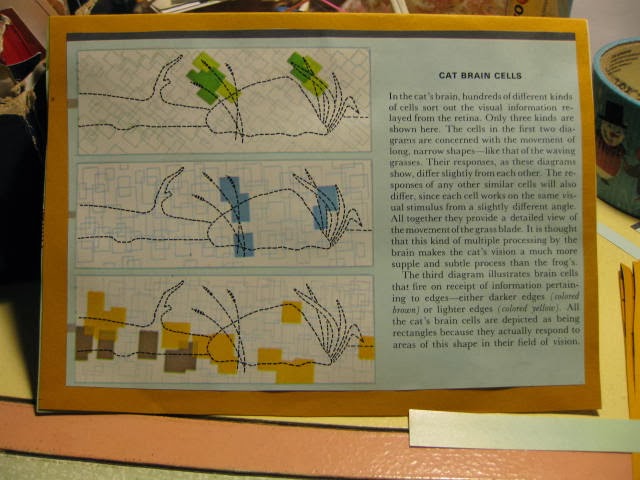
Card for Glenn, Interior. This is an illustration of cats' visual neural pathways, as compared to frogs'.


Card for Susan
Calendar for Lara (images are mostly from Nikki McClure)


Birthday card for Hilary


Pillowcase for Erin F.

Calendar for Sam
Card for Jackie?
Wedding Card for Jim and Jovanie, finally legally wed in California after 16 years
I made this card out a chopstick wrapper I kept in my craft supplies box for years. I know there is a serious danger of becoming a hoarder and clutterer when you keep chopstick wrappers but I loved the geometrical design and now it is art that I gave to someone else and is no longer in my house. So there.

Tuesday, December 31, 2013

crafting thanks in 2013

This year, I was thankful for...

1. My friends for donating to my I Think I Can campaign to raise money for a great organization that serves homeless youth. Thanks to the campaign, I raised $300.00 for At the Crossroads, gave up sugar for five months, and lost 15 lbs. Now, seven months later, after a breakup, a death in the family (more on that later), and many hours of Mad Men and Parks & Recreation, I am right back where I started. Luckily, the ITIC campaign is rolling into the station again, so I guess I'd better hop on board and make it year-long this time.

(On a side note, as a public health practitioner I have to look at the unfathomable amount of salt-sugar-and-fat-filled objects labelled as food to which we are visually exposed  and seduced to consume. I would love, as a public health performance art piece, to go to Trader Joe's, take out all the products that have refined sugar, put them in neat piles in the parking lot, take photographs of what remained in the store, and measure what proportion of the shelves remained empty sans sugar, and then do the same for salt and refined flour. I suspect it would be something like 75% of the store's products out in the parking lot, with only produce and raw nuts left inside.)

In lieu of structural changes to remove sugar from my environment, guilt and money work as cues; here are some of the thank you cards I made for friends who donated to my 2013 I Think I Can campaign:
Hank
Sarolta
Daliah (Front)

Daliah (Interior)
 2. Revolutionary artists like Ruth Asawa for integrating community, family, and politics into her work while transcending all of those things to make beautiful art. I was good friends with her grandson in middle school and remember him telling me she had designed a fountain in Ghiradelli Square, but I only later understood the true importance of her work to San Francisco and to my own life. Asawa survived U.S. internment of Japanese-Americans to become an influential artist, feminist, and advocate for arts education. She was a member of the board at SCRAP, where I first tried my hand at sewing after stuffing cotton prints and corduroys in my pockets during hours of sorting through donations of fabric and other recycled art supplies. She also helped found the School of the Arts, where I studied theater in high school, and which was recently renamed in her honor. Her famous Ghiradelli Square fountain showed a mermaid breastfeeding her baby, an unabashed depiction of female power and celebration of joy, motherhood, and life. According to the New York Times obituary for Asawa, the fountain "set off a freewheeling debate about aesthetics, feminism and public art." Given the need for laws allowing breastfeeding in public, the relevance of her work continues.
R.I.P. Ruth Asawa, one awesome lady. 

Card for Ken Cuneo on the death of his grandmother, the artist Ruth Asawa
3. My family, for coming together to remember the loss of my father. His death, after seven years of being missing, is a long story I will tell another time. But I was grateful for the opportunity to mourn with family, and for their support in making his memorial possible.

For my sister        

For my uncle and aunt


For my brother, Eliyahu (artwork by Nikki McClure)
For my brother Sacha (linoleum cut by Melissa Klein)
4. Finally, I am grateful to my friends and coworkers for giving me love, entertainment, and support. And so I thanked them this year during the holidays (and cleared out a worrisome number of accumulated jam jars) by making  my first-ever batches of candied almonds and granola. (Thanks also to holiday duct-tape!)
For Britt and Erock

May we all live with ease and well-being in our hearts. 
Happy New Year!

Saturday, January 26, 2013

creature comforts: cookies, pillows, linens, cards

In times of loss, of crisis, of love, one feels moved to make things, be it with music or canvas or needle and thread. I've recently lost someone with whom I had a shared history, however, distant, and had others close to me lose their loved ones: mothers, brothers, in-laws, cousins they never knew but heard about in the news, comrades. Here are some things I've made of late (and a few things friends have shared) in memory of friends and family members passing into the netherworld, and in celebration of their lives here on earth and all of the incredible things they taught us. If only we remembered to appreciate our friends and their tremendous affect on the trajectories and qualities of our lives while they are still very much living. It is not too late. These gifts for friends and colleagues in honor of their lives and strengths and losses are offered in this spirit.

Cookie with banner for Sarah Kirsch
 
 In loving memory, Sarah Kirsch, 1970-2012

Sarah's recent passing has left me reeling, even though I haven't seen her in a couple years. She was part of a formative period of my life, one filled with vegan food (including many carob chip cookies, delivered to my door) and thoughtful politics and potlucks and punk music, with finding straightedge to my incredible relief and then, later, drifting apart in search of queerer community, only to learn just a year before her death that she identified as transgender and had been living her life as a closeted male-passing punk for too many years. To me, it is such a testament that regardless of exterior appearances, we are all so very precious and tender on the inside and need to be handled with such care and gentleness if we are ever to grow.

 
 Pillow for Alessandra, front, in memory of her mother; the two of them are pictured here. 

Pillow for Alessandra, back

 Pillow Cases for Joan, "We are all..."
 "alone..."
 "in this world..."
 "...together."
 
(Thanks to Xylor Jane and Xara Thustra for their poster (above) and the inspiration.) 
 
Card for Joan, "May your happiness (etc.) continue..."
 
(Thanks to Spring Washam for the phrase (above) and the inspiration.)


Tuesday, September 25, 2012

Impressions of Barcelona, Part I: The Streets


Coming to Barcelona, I didn't know what to expect. I had wanted to go there for the past 15 years but didn't even have a clear idea why. I realize now that it was this scene from the movie Barcelona (1994):

 That was my subconscious reason. Consciously, I'd heard it was a great city, full of great art and architecture, and I wanted to see the town that had been a last anarchist holdout in the Spanish Civil War and the site of great collectivization and resistance against the fascism of Franco, or so I'd heard.
It was strange, then, to see anarchist, communist, socialist, feminist, Catalan nationalist/separatist (more on that later) slogans in red and black and wheatpaste strewn across the city in response to the financial crisis but to find little public commemoration of Barcelona's incredible history during the Spanish Civil War.
Anticapitalist demonstration
Enough with the bankers, politicians, corrupt robbers, enough!
"How much are you worth/How much do you cost?"
"Wildcat strike"
"Capitalism IS the crisis"
"Independence, Socialism, Feminism"
"Capitalism is a Pyramid Scheme"


"Freedom for Catalan Countries"
 It was only after taking an excellent tour led by Nick Lloyd of Iberianature and then reading Homage to Catalonia by George Orwell and other books on the war from the library that I realized why: while there may have been a good six months in which 70-80 percent of the businesses in Barcelona had collectivized and the feeling of liberation and possibility and the songs of revolution rang through the streets, there was also soon a brutal period when members of the left executed thousands of members of the clergy, destroyed churches and cathedrals, and desecrated religious icons and symbols (the Catholic church was aligned with the fascists and the right and was responsible for its own share of terrors, but still). It was a testament to this conflict that Nick told us that he'd had a dozen Barcelona locals tell him, "If you take people anywhere in Barcelona, take them to the Placa Sant Felip Neri. This is where they shot the priests." While in fact the damage to the church wall came from shrapnel from a fascists' bomb in 1938, the perception of what happened is as important as what actually happened, because it speaks to what lies underneath, in peoples' collective memories. Even if it didn't happen in this exact place, it did happen, and people did not forget.
"In memory of the victims of the bombing of Sant Felip Neri. Here died 42 people, most of the children, from the actions of a Francoist plane on the 30th of January, 1938"
The walls of the Plaza de Sant Felip Neri
As much as I'd seen images from revolutionary Spain in books of art and resistance, I'd never seen this or understood what it represented, even in its mythology, to the conservative side of Spain. Even now, I was genuinely shocked to see, on a church in the Poble Nou neighborhood, graffiti that said "Fuck the pope." But I'm not Catholic and so, as much as I have an abstract understanding of the archaic views of the Vatican vis a vis the rights of reproductive rights of women and the sanctity (or lack thereof) in being gay, I don't have the same visceral reaction to it that others do who have been steeped in its indoctrination throughout their lives.
 ***
What I did have a visceral reaction to was being in the midst of a nationalist demonstration on the 11th of September, National Catalonia Day, when hundreds of thousands of people flooded the streets of Barcelona to demand independence from Spain (and, most likely, to also protest the economic austerity measures proposed by the Spanish government in response to the ever-deepening economic crisis in Europe).
Poster for Catalonian Freedom March
Just like for gay pride in San Francisco, there were swarms of people draped flags and marching in what seemed like every direction. Only instead of rainbow flags they bore the red and yellow stripes of Catalonia.
National Catalonia Day, 11th of September, 2012, Barcelona
Bikes for Catalonia


Even when it is for a potentially righteous cause, there is something about a large group of people bearing a flag *of any kind* that scares me. Because the flip side of belonging to the group bearing that flag is not belonging and then wondering if you are welcome at all. And that is not to say that community boundaries are inherently bad; sometimes they are critical for survival of the group; people have a human right to dignity and self-determination. It's just that with borders, while you  might benefit from staying in, who's to say that you will be allowed to leave? (Think: East Germany.) And conversely, when you keep others out, how do you maintain your connections with the people on the other side? (Think: The Israeli West Bank Wall.)

When I asked Nick what the anarchists in Barcelona thought of Catalan independence, he said they were totally against it, but that overall half of his friends were against it and half of them were for it. (A split, see?) I don't know enough about Catalonia one way or another to have an educated opinion. It's just a feeling I get in my chest and one that I'm inclined to listen to. In a crowded movie theater, know where the exits are.
 ***
The day after the protest the newspapers showed emboldened Catalan leaders, promising reforms. 
"The president shows his intention to start constructing structures of statehood; the government intends to combat the image of Spain as the enemy of Catalonia."
"Everything is possible.
 

Sunday, June 10, 2012

Keeping Afloat in Streetopia

Last month, I had the opportunity to install an interactive mixed media piece at Streetopia, the large-scale group exhibition at the Luggage Store Gallery, 509 Cultural Center, and other spaces in downtown San Francisco, curated by my friend Erick Lyle and others, to envision Utopian aspirations for the city.

When Erick put the call out for contributions to the show, I thought of a lot of things I wanted to do, including an interactive installation that only worked when two or more people cooperated on it together and workshops on paradigm-changing books by INCITE! Women of Color Against Violence, one on envisioning a shift back from social services to social justice, and another on the (im)possibilities of community accountability for acts of intimate partner violence in lieu of prisons, jails, and probation officers.

What got through the filter of my time commitments and feasibility within the physical and chronological space was this piece, called "What keeps you afloat?" Its components are simple: a question, a tub of water, and pencils, crayons, twigs, string, and paper boats--tools with which to answer the question.


The question came to me when considering my own participation in utopian social movements, of exhausting and exhilarating hours spent planning and carrying out actions--marches, squats, free cafes--to protest our society's ills--greed, hubris, war--and to show the world we want to live in, a world without those things.

It came to me when thinking about previous utopian social movements in the San Francisco Bay Area, like the Digger Houses, Wheeler Ranch, and Morningstar Ranch, places my mother lived before my siblings and I were born. It came to me when reading Cometbus #48, the zine in which punks whose parents had been "back-to-the-landers" recalled witnessing communities and families coming together, sometimes making beautiful things, and often tearing each other apart. It came to me when contemplating my own measured involvement in more recent manifestations of the immutable search for human dignity, like Occupy Oakland.

It seems to me, in connecting these different moments, that a fundamental difficulty that we face is in taking care of ourselves whilst participating in larger configurations, whether they be friendships or relationships or families or communities or movements for social change. By care I mean meeting our deep needs for connection and purpose and dignity while at the same time meeting our basic needs--for sustenance, for safety, for rest.  (For me, this meant attending the General Assembly meetings at Occupy Oakland and then going home to bed rather than staying in a tent in Oscar Grant Plaza and fighting the cops at 3 a.m.)

But maybe what I should be asking is how we take care of ourselves in isolation from each other, and if this is even possible. Because as much as I know that I cannot sustain the kind of energy I had in my 20s for raucous riot girl shows or turbulent antiwar protests, I also cannot live without connection or community, much as I would like to try at times. What I have come to realize is that the two things are mutually dependent: In order to participate in community, I need to take care of myself; in order to care for myself, I need community.

My contribution to the conversation about Utopian visions of San Francisco was to pose this question, "What keeps you afloat?," in a way that enabled people responding to the question to take care of themselves--through reflection, and each other--through sharing insights. Here are some pictures of what the installation has looked like.  I'm also keeping a list of the answers I've received so far.
May 18, Day One, Six Boats
By the end of the first night, the tub was full and the boats were saturated. Others had said to me, "I hope the boats don't sink, that would be so sad." But when it happened, it wasn't, somehow. Instead, to me at least, it just felt like the boats of others who had come before were holding the new ones aloft.
May 18, Day One, Full


Still, I wanted to make space for new additions and to preserve what people had written. So I came back and pulled the saturated boats from the water and strung them along clotheslines, for all to read.
 
May 19, Day Two, Clotheslines
And as the show continues, I repeat the process of pulling the boats out and stringing them on clotheslines, making space for more paper boats and messages, more signals to ourselves and each other on taking care.
June 4, Day 18, "Tacos, My Mom, Love"
 (Streetopia continues through June 23, Luggage Store Gallery, 1007 Market St., in San Francisco.)

Sunday, May 20, 2012

Solar Eclipse, Lake Merritt Park, Oakland

On May 20, 2012, the moon passed in front of the sun, making a ring of fire in some parts of the world, and a lovely crescent out of the shadows in Oakland. Shown here, finger shadows and light shining through the leaves on a tree trunk in the park at Lake Merritt.